卡片召唤师
精华
|
战斗力 鹅
|
回帖 0
注册时间 2022-9-18
|
本帖最后由 与天争锋_L 于 2026-3-28 18:00 编辑
先传图片,文字等我慢慢一段一段复制下
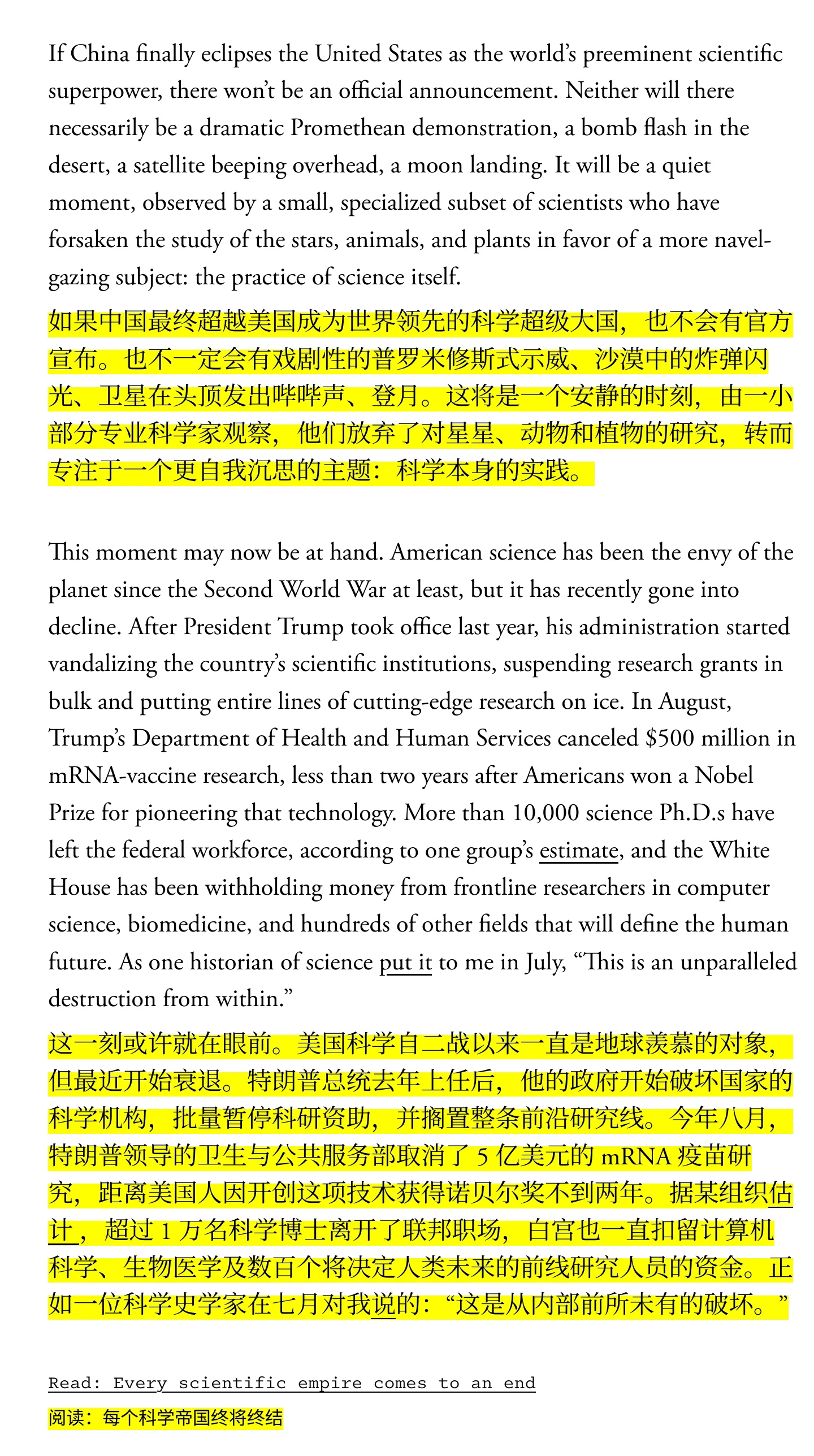
If China finally eclipses the United States as the world’s preeminent scientific superpower, there won’t be an official announcement. Neither will there necessarily be a dramatic Promethean demonstration, a bomb flash in the desert, a satellite beeping overhead, a moon landing. It will be a quiet moment, observed by a small, specialized subset of scientists who have forsaken the study of the stars, animals, and plants in favor of a more navel-gazing subject: the practice of science itself.
如果中国最终超越美国成为世界领先的科学超级大国,也不会有官方宣布。也不一定会有戏剧性的普罗米修斯式示威、沙漠中的炸弹闪光、卫星在头顶发出哔哔声、登月。这将是一个安静的时刻,由一小部分专业科学家观察,他们放弃了对星星、动物和植物的研究,转而专注于一个更自我沉思的主题:科学本身的实践。
This moment may now be at hand. American science has been the envy of the planet since the Second World War at least, but it has recently gone into decline. After President Trump took office last year, his administration started vandalizing the country’s scientific institutions, suspending research grants in bulk and putting entire lines of cutting-edge research on ice. In August, Trump’s Department of Health and Human Services canceled $500 million in mRNA-vaccine research, less than two years after Americans won a Nobel Prize for pioneering that technology. More than 10,000 science Ph.D.s have left the federal workforce, according to one group’s estimate, and the White House has been withholding money from frontline researchers in computer science, biomedicine, and hundreds of other fields that will define the human future. As one historian of science put it to me in July, “This is an unparalleled destruction from within.”
这一刻或许就在眼前。美国科学自二战以来一直是地球羡慕的对象,但最近开始衰退。**总统去年上任后,他的政府开始破坏国家的科学机构,批量暂停科研资助,并搁置整条前沿研究线。今年八月,**领导的卫生与公共服务部取消了 5 亿美元的 mRNA 疫苗研究,距离美国人因开创这项技术获得诺贝尔奖不到两年。据某组织估计 ,超过 1 万名科学博士离开了联邦职场,白宫也一直扣留计算机科学、生物医学及数百个将决定人类未来的前线研究人员的资金。正如一位科学史学家在七月对我说的:“这是从内部前所未有的破坏。”
Read: Every scientific empire comes to an end
阅读:每个科学帝国终将终结
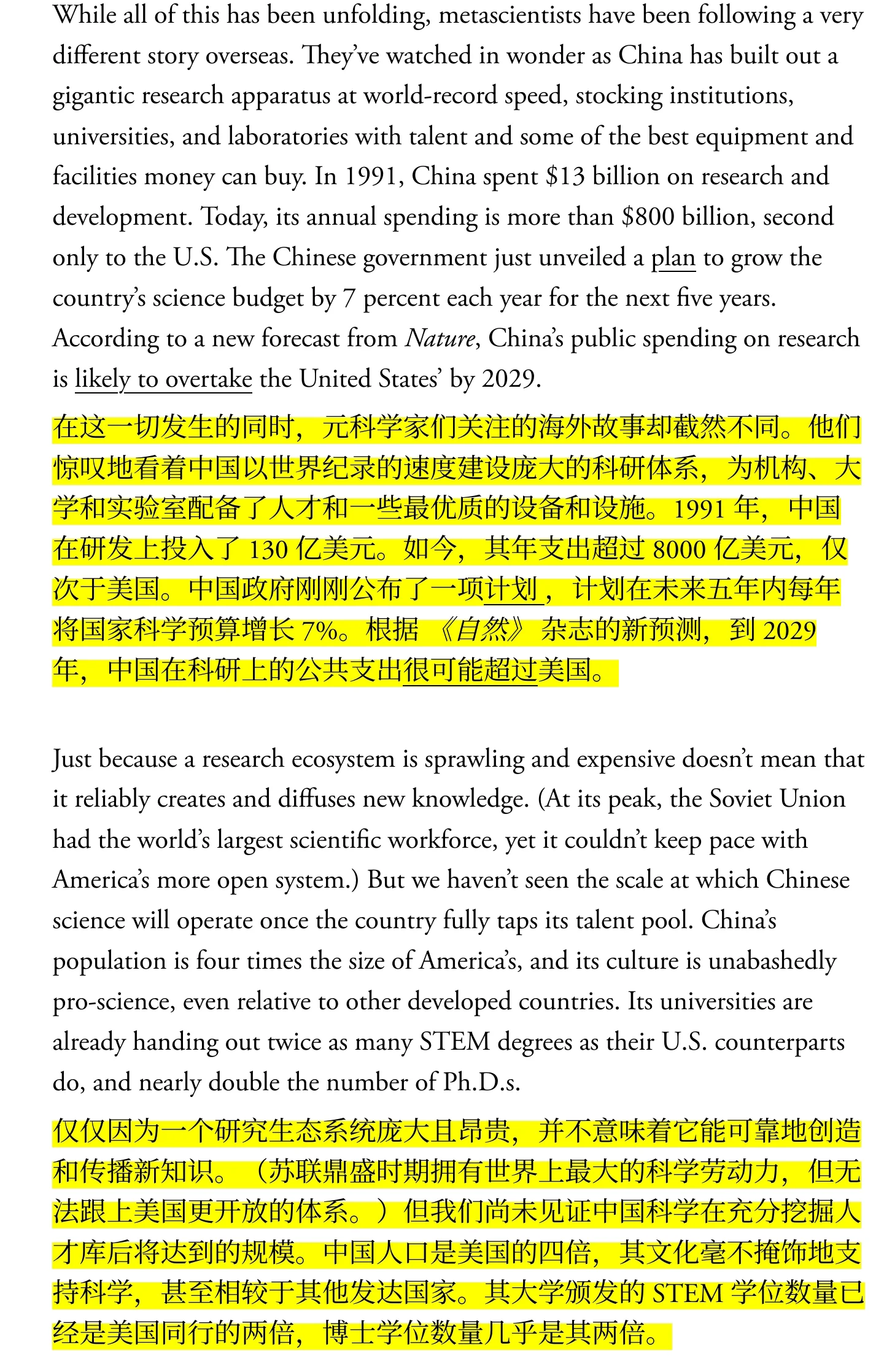
While all of this has been unfolding, metascientists have been following a very different story overseas. They’ve watched in wonder as China has built out a gigantic research apparatus at world-record speed, stocking institutions, universities, and laboratories with talent and some of the best equipment and facilities money can buy. In 1991, China spent $13 billion on research and development. Today, its annual spending is more than $800 billion, second only to the U.S. The Chinese government just unveiled a plan to grow the country’s science budget by 7 percent each year for the next five years. According to a new forecast from Nature, China’s public spending on research is likely to overtake the United States’ by 2029.
在这一切发生的同时,元科学家们关注的海外故事却截然不同。他们惊叹地看着中国以世界纪录的速度建设庞大的科研体系,为机构、大学和实验室配备了人才和一些最优质的设备和设施。1991 年,中国在研发上投入了 130 亿美元。如今,其年支出超过 8000 亿美元,仅次于美国。中国政府刚刚公布了一项计划 ,计划在未来五年内每年将国家科学预算增长 7%。根据 《自然》 杂志的新预测,到 2029 年,中国在科研上的公共支出很可能超过美国。
Just because a research ecosystem is sprawling and expensive doesn’t mean that it reliably creates and diffuses new knowledge. (At its peak, the Soviet Union had the world’s largest scientific workforce, yet it couldn’t keep pace with America’s more open system.) But we haven’t seen the scale at which Chinese science will operate once the country fully taps its talent pool. China’s population is four times the size of America’s, and its culture is unabashedly pro-science, even relative to other developed countries. Its universities are already handing out twice as many STEM degrees as their U.S. counterparts do, and nearly double the number of Ph.D.s.
仅仅因为一个研究生态系统庞大且昂贵,并不意味着它能可靠地创造和传播新知识。(苏联鼎盛时期拥有世界上最大的科学劳动力,但无法跟上美国更开放的体系。)但我们尚未见证中国科学在充分挖掘人才库后将达到的规模。中国人口是美国的四倍,其文化毫不掩饰地支持科学,甚至相较于其他发达国家。其大学颁发的 STEM 学位数量已经是美国同行的两倍,博士学位数量几乎是其两倍。
For almost a decade now, Chinese scientists have been publishing more papers too. Again, the sheer volume of this effort gives us only a coarse sense of what’s happening there. When China began to dominate that metric, some of its universities were paying cash rewards to scholars for each publication, and a lot of Chinese research papers were shoddy make-work. The government has since ordered universities to stop encouraging academic mass production. The factors that drive salaries and promotions for professors are now more fine-grained, and it shows: China’s share of the world’s most widely cited scientific papers has grown, Caroline Wagner, a professor at Ohio State University who studies scientific policy, told me. In 2023, Chinese scientists produced 58,000 of the world’s roughly 190,000 most influential publications, according to Wagner. Their contribution was second only to the United States’. Wagner likes this metric because it’s relatively hard to game (though some Chinese scientists do seem to be trying).
近十年来,中国科学家也不断发表更多论文。同样,这份工作的量让我们只能粗略地了解那里发生了什么。当中国开始主导这一指标时,一些大学会为每篇论文向学者支付现金奖励 ,许多中国研究论文都是粗糙的拼凑稿。政府随后下令大学停止鼓励学术大规模生产。推动教授薪酬和晋升的因素现在变得更加细致,这一点可以看出来:俄亥俄州立大学科学政策研究教授卡罗琳·瓦格纳告诉我,中国在全球被引用率最高的科学论文中的份额有所增长。据瓦格纳称,2023 年中国科学家发表了全球约 19 万篇最具影响力的出版物中的 5.8 万篇。他们的贡献仅次于美国。瓦格纳喜欢这个指标,因为它相对难以控(尽管有些中国科学家似乎在尝试 )。
If you were building a bespoke dashboard to monitor the state of science in China, you’d have many such data streams to choose from. The problem is, they’d all be lagging indicators. We can’t easily assess the quality of research that China’s scientists are doing today, because that work won’t be published for another year or two at least, and then its scientific influence—measured by the resulting papers’ citation rates—won’t peak until a few years after that, on average. (Some papers experience a citation boom even later; metascientists call them “sleeping beauties.”) Nobel Prizes have an even more dramatic lag: So far, only one Chinese scientist has earned a Nobel for scientific work done in China, but Nobel laureates are often summoned to Stockholm decades after they’ve completed their revolutionary research.
如果你要打造一个专门的仪表盘来监测中国的科学状况,你会有许多这样的数据流可供选择。问题是,它们都会变成滞后指示器。我们无法轻易评估中国科学家今天的研究质量,因为这些工作至少还要一两年才能发表,而其科学影响力——以论文引用率衡量——平均要到几年后才达到顶峰。(有些论文引用量甚至更晚,元科学家称之为“沉睡的美文”。)诺贝尔奖的颁奖滞后更为显著:迄今为止,只有一位中国科学家因在中国的科学工作获得诺贝尔奖,但诺贝尔奖得主往往在完成革命性研究数十年后被召回斯德哥尔摩。
In the meantime, we do have some more immediate signs that Chinese scientists are ascendant. Last year, a team of American and Chinese researchers published an analysis of international research collaborations. Their machine-learning model identified the lead authors of nearly 6 million scientific teams to see who was actually in charge. The team found that among U.S.-China collaborations, the share of leaders who were affiliated with Chinese institutions had grown from 30 percent in 2010 to 45 percent in 2023. The researchers projected that China will pull even with the U.S. next year or in 2028 at the latest.
与此同时,我们确实有一些更直接的迹象表明中国科学家正在崛起。去年,一支由美中研究人员组成的团队发表了一项关于国际研究合作的分析。他们的机器学习模型识别了近 600 万个科学团队的主要作者,以了解谁才是真正的领导者。研究团队发现,在美中合作中,隶属于中国机构的领导人比例从 2010 年的 30%增长到 2023 年的 45%。研究人员预测,中国明年或最迟 2028 年将与美国持平。
In the end, China’s scientific-superpower status will likely depend on the world-changing force of its discoveries. “We don’t just want papers,” Yian Yin, a professor of information science at Cornell, told me. “We want papers that turn into real theoretical insights or technologies.” Some of these can be tracked by looking at how research is cited in patent applications, but this additional diffusion can introduce its own lag of 10 years or more. Even so, China’s fast rise in the applied sciences is already obvious, Yin said. The country is in the midst of a solarpunk revolution. Thanks to its advances in chemistry and materials science, China has caught up with or surpassed the U.S. in the design and manufacture of advanced batteries, electric vehicles, and solar cells—key technologies for the 21st century.
最终,中国的科学超级大国地位很可能取决于其发现所带来的世界变革力量。“我们不仅仅是想要论文,”康奈尔大学信息科学教授尹妍告诉我。“我们要的是能转化为真正理论见解或技术的论文。”其中一些可以通过研究在专利申请中的引用方式来追踪,但这种额外的扩散可能会带来10年甚至更长时间的延迟。尹表示,尽管如此,中国在应用科学领域的快速崛起已经显而易见。这个国家正处于一场太阳能朋克革命的中心。得益于化学和材料科学的进步,中国在先进电池、电动汽车和太阳能电池的设计制造方面已追赶甚至超越美国——这些是21世纪的关键技术。
Future historians of science will have a better perspective on precisely when the torch-passing occurs, if it does. The significance of a scientific achievement is not always easy to recognize in real time. When Chinese alchemists invented gunpowder in the ninth century, no one grasped the full range of its potential uses. It was initially thought to be a curiosity, a firework or a special effect, until Song-dynasty arms dealers started using it to make fire arrows and other military explosives. European scientists heard about it only centuries later.
未来的科学史学家将对火炬传递的确切时间有更清晰的认识。科学成就的重要性并不总是在实时中容易被认识到。当中国炼丹术士在九世纪发明火药时,没有人真正理解其潜在用途的全部范围。起初人们认为它只是个奇观、烟花或特殊效果,直到宋代军火商开始用它制造火箭和其他军用炸药。欧洲科学家直到几个世纪后才听说它。
A thousand years before that, when the Chinese invented paper, they initially used it for padding and packing. No one thought to use it for disseminating knowledge. About that same time, Chinese scholars were compiling the Jiuzhang Suanshu, a mathematical treatise focused on solving practical problems with computation. There are 246 of them, drawn from the everyday realms of agriculture, land surveying, and taxation. One chapter includes a matrix technique. It is now regarded as an early intellectual ancestor of matrix-based linear algebra, which powers neural networks, up to and including large language models.
在一千年前,中国发明纸张时,最初用纸来填充和包装。没人想到用它来传播知识。大约在同一时期,中国学者正在编纂《 九章算书 》,这是一部专注于用计算解决实际问题的数学著作。共有 246 人,来自农业、土地测量和税务等日常领域。其中一章包含矩阵技巧。它现在被视为基于矩阵的线性代数的早期智力前身,矩阵线性代数驱动神经网络,甚至包括大型语言模型。
History is a story that we tell ourselves about how we got to the present, and if China soon sits atop the sciences, history will be reinterpreted. China’s past glories may be recast as part of an extended narrative of dominance, and America’s eight-decade reign may come to be regarded as a mere blip.
历史是我们讲述自己如何走到今天的故事,如果中国很快登上科学之巅,历史将被重新诠释。中国过去的辉煌或许会被重新塑造成长期的统治叙事的一部分,而美国八十年的统治也可能被视为昙花一现。
|
评分
-
查看全部评分
|

 沪公网安备 31010702007642号 )



 发表于 2026-3-28 17:55




 高校一个硕导就是一个团队啊